Showing posts with label Singer Songwriters. Show all posts

Thursday, February 17, 2022

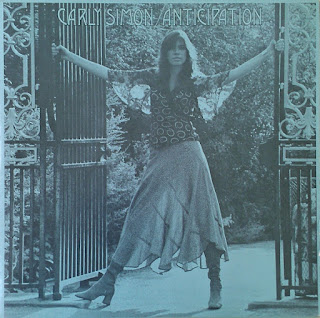
Top 40 Entry 1/1/72: Carly Simon - "Anticipation"


Carly Simon — “Anticipation” (#13). Elektra 45759. Top 40 debut: 1/1/72. Peak date: 2/12/72. Written by Carly Simon. Produced by Paul Samwell-Smith. B-side: “The Garden.” LP: Anticipation. Charts: Billboard Hot 100 (#13), Easy Listening (#3).

Carly Simon’s debut single (“That’s the Way I Always Heard It Should Be, #10 in 1971), a quiet ballad with a big, Bacharach-style chorus, broke new ground for pop songs by looking at relationships from a psychoanalytical perspective. Fittingly, its sophisticated musical roadmap also offered rewards to those listeners with grown-up attention spans. The record practically demanded, on its own, the creation of a radio format to be known as “adult contemporary." Simon’s next single, “Anticipation,” which led off her second album, gave it its title, and did almost as well, peaking at #13. It followed the lead of "That's the Way" by reinforcing her reputation as pop music’s star reporter in the trenches of modern romance. She had lots of material, and you can read about it in her Boys in the Trees (2015) memoir.

Here’s one tidbit: “Anticipation” came from a date night with Cat Stevens, with whom she’d often shared the stage and also a producer in former Yardbird Paul Samwell-Smith. She had cooked dinner, but because the Teaser and the Firecat album icon took his time getting there, she at least got a song written while she waited. Such a well-crafted result, which became one of the quintessential radio hits for the singer-songwriter era, says as much about her creative skills as it does about right place/right time factors. (Stevens would sing background vocals on the album’s “Julie Through the Glass.”) The radio heyday of “Anticipation” coincided with Simon winning the Best New Artist Grammy for 1971, a ceremony that also handed Carole King the Record of the Year (“It’s Too Late”) and Song of the Year (“You’ve Got a Friend”). A golden age for women singer songwriters was evidently underway.

“Anticipation,” though—and this is not in Simon’s memoir—would become best known as a Heinz ketchup TV commercial theme from 1973 well into the eighties. In the present day, hit songs rent themselves out for commercial usage as standard practice. In the sixties and seventies, it tended to go the other way around, with popular commercial themes turning into jingle singles for radio. Simon’s record, then, anticipated a whole new era in pop music marketing.

The only other single from the Anticipation album, “Legend in Your Own Time,” missed the Top 40, peaking at #50. That song was almost universally understood, especially in light of her next big hit “You’re So Vain,” as a takedown of some male subject in a “legend in your own mind” kind of way. Her memoir, though, makes clear that she wrote it, with tenderness to boot, about future husband James Taylor, whom she had met when they were much younger and whose mother, apparently, didn’t have a music career in mind for her boy. He would become a legend, then, according to his own timetable.

Side A: "Anticipation"


Side B: "The Garden"

Friday, December 28, 2018

Chart Song Cinema: The Last American Hero (1973)


Songwriters Norman Gimbel and Charles Fox, at the early stages of prolific careers, had no idea they were writing the epilogue for singer-songwriter Jim Croce, a man who generally manufactured his own music and lyrics. But his performance of their "I Got a Name" on record sounded like something he'd have come up with eventually, and it ended up being the last song he'd perform on this earth, at a concert in Natchitoches (NACK-itosh), Louisiana, after which his charter plane would crash during takeoff on September 20, 1973.

"I Got a Name" was scheduled for release as a single one week after that sad day and had already been assigned as the opening and closing title theme for a movie called The Last American Hero. In spite of its big title, this was a fairly easy-going film starring Jeff Bridges as a charismatic and resilient Junior Johnson-style moonshiner-turned-stock car racer, the type Croce sang about on his 1972 You Don't Mess Around with Jim album ("Rapid Roy (The Stock Car Boy)").

Although its down-home footage of dirt track racing will give gearheads from any era a nice cinematic buzz, nothing in the film packs enough of a dramatic wallop to call for the emotional gravitas in "I Got a Name," a recording that dresses up its rural lyrical and musical components in orchestral lace. Both the film title and theme song could have worked better in some other film with a more heart-wrenching premise. (But here's a line worth remembering, spoken by the Bridges character's repentant bootlegger dad: "The damn foolishness of one person is the breath of life to another.")

"I Got a Name" would be Croce's fifth charting single, with six more posthumous ones to come between 1973 and 1976, including the career/genre/era-apotheosis piece "Time in a Bottle." Quentin Tarrantino grabbed "I Got a Name" for one of his crazy-quilt soundtracks in 2012 (Django Unchained). Side B merged lyrics evoking the blue collar south to etude-like music that seemed suited for harpsichord.


"I Got a Name" (1973) - Jim Croce

Written by Norman Gimbel and Charles Fox * Produced by Terry Cashman and Tommy West * 45: "I Got a Name" / "Alabama Rain" * LP: I Got a Name * Billboard charts: Hot 100 (#10), Easy Listening (#4) * Entered: 1973-10-06

Side A: "I Got a Name"


Side B: "Alabama Rain"

Saturday, June 25, 2016

Gordon Lightfoot - "If You Could Read My Mind" (1970)

Gordon Lightfoot - "If You Could Read My Mind" (Billboard #5, entered 12/26/70; easy listening #1). Written by Gordon Lightfoot. Produced by Lenny Waronker and Joe Wissert. 45: "If You Could Read My Mind"/"Poor Little Allison" (Reprise 1970). LP: If You Could Read My Mind (Reprise 1970).

When Gordon Lightfoot entered the American charts for the first time in late 1970, he had already become an iconic Canadian chart fixture, with his first hit happening in 1962. But he'd also seen other performers' versions of his compositions do well in the U.S., such as Marty Robbins's 1965 country #1 "Ribbon of Darkness" and Peter, Paul and Mary's Top 40 version of "For Lovin' Me" (1965).

In 1969, Canadian hitmakers The Guess Who memorialized Phase One of the troubadour's career with a tribute song called "Lightfoot" on their Wheatfield Soul album. Lightfoot launched Phase Two with "If You Could Read My Mind" (a musical relative of the poignant Midnight Cowboy theme, with its root-to-flatted seventh opening chord sequence), which became an instant standard and role model for the forthcoming singer-songwriter era.

In 1977, the George Benson hit "The Greatest Love of All," with music by Michael Masser, plagiarized a key musical passage - chords and melody - from "If You Could Read My Mind." When Whitney Houston had an even bigger hit with it in 1985, Lightfoot finally broke down and lawyered up, only to withdraw the suit in the belief that it would do too much indirect damage to Houston.

Gordon Lightfoot - "If You Could Read My Mind"

See also: A KMPC Playlist circa 1971

Friday, February 27, 2015

Four Charting Versions of "Rings": Who's on the Stereo?

"Rings" was a #17 hit for Cymarron, a soft rock trio who'd later team up with Bread's Jimmy Griffin in the '90s as the Remingtons. Written by pro songwriters Eddie Reeves and Alex Harvey (not the British cult rocker), the song's lyrics toyed with telephones, doorbells, and wedding bands, and suggested that success in romantic relationships correlated with the comfort level of one's living room. Four versions of this song charted in Billboard in the early seventies, each of which altered the original line, "I've got James Taylor on the stereo," with a different artist in JT's place.

Cymarron - "Rings" (Billboard #17, entered 6/12/71)Written by Eddie Reeves and Alex Harvey. Produced by Chips Moman. 45: "Rings"/"Like Children" (Entrance 1971). LP: Rings (Entrance 1971).

Who's on the stereo? James Taylor.


Tompall and the Glaser Brothers - "Rings" (Billboard country #7, entered 9/18/1971). Written by Eddie Reeves and Alex Harvey. Produced by Jim Glaser. 45: "Rings"/"That's When I Love You the Most" (MGM 1971). LP: Rings and Things. 

Who's on the stereo? Merle Haggard.

Lobo - "Rings" (Billboard #43, entered 7/20/74). Written by Eddie Reeves and Alex Harvey. Produced by Phil Gernhard. 45: "Rings"/"I'm Only Sleeping" (Big Tree 1974). LP: Just a Singer (Big Tree 1974).

Who's on the stereo? The Allman Brothers. The B-side is a sleepy cover of the 1966 Beatles tune.


Reuben Howell - "Rings" (1974, Billboard #86). Written by Eddie Reeves and Alex Harvey. Produced by Clayton Ivey and Terry Woodford. 45: "Rings"/"I'll Be Your Brother" (Motown 1974). LP: Rings (Motown 1974).

Who's on the stereo? Jim Croce.

Reuben Howell (a Motown label Caucasian) and Lobo, by the way, both entered Billboard's Hot 100 on the same day - July 20, 1974. Both of their versions also bypassed the poignant flat-VII (coinciding with "laugh and sing") that appeared in the choruses of Cymarron's version. Why did they both surface with similar renditions exactly three years after the song's first flurry of success?

Other non-charting versions: Leo Kottke did a version of the song in 1983, expertly inserting Mel Blanc as the "on the stereo" artist but also bypassing the flat-VII. In a 1982 version by Dr. Hook, they're listening to "sweet music."  And commenter James Porter has clued me in on a 1971 version by Lonnie Mack, who sticks with James Taylor on the stereo.

Sunday, February 8, 2015

Singer-Songwriters and the "No Fault Divorce" Law

James Cushing, quoted in Harvey Kubernik's Turn Up the Radio!: Rock, Pop, and Roll in Los Angeles 1956-1972 (p. 232): "People say that the singer-songwriter genre happened because people were recovering from the sixties, but I think there's another reason - California adopted the 'no fault divorce' law in July 1970, and then the rest of the country followed suit. Before that time, it was really hard to get a divorce. You had to prove so many things, hire lawyers to get photographs, like Jake Gittes in Chinatown. Prior to 1970, the California Supreme Court ruled that, from now on, there will be exactly two reasons for divorce: incurable insanity or irreconcilable differences.

"This new law had enormous impact on everyone - the people who made the music, who listed to the music, who sold the music, their secretaries, their lawyers, and the listeners with their radios. All of a sudden, none of them had to worry about hiring a divorce detective. Now, if you got sick and tired of your spouse, you could get divorced right away. So it seemed that everybody got divorced.

"From an observer's viewpoint, divorce can be very liberating for both parties, but, according to psychologists, it's the equivalent of a death in the family, in terms of persona trauma. So everybody's newly liberated, but traumatized. In light of this situation, James Taylor singing 'You've Got a Friend' sounds really good. But Jim Morrison singing 'Break on Through' does not sound as good, because you've just broken on through to the other side of the conventional life, and now that you've broken on through, you're stuck with the fact that it's broken, and you broke it. I hope you like it broken, That's what you wanted. Oh, but you feel a strange nostalgia for the unbroken? You've got a friend."

Friday, January 6, 2012

Fire and Rain and the "James Taylor Controversy"

Before I talked about my Early ‘70s Radio book as part of the “Views and Brews” series at the Cactus CafĂ© last October, the notion of a “James Taylor controversy” managed to work its way into the promotional language of Austin's KUT, who sponsored the event. The phrase turned out to be a pretty crafty attention-getter, prompting a flurry of phone calls and emails. What could possibly be controversial about James Taylor?, people wondered. Why haven’t I ever heard about this?

Taylor’s non-controversial persona was the controversy. Many among those who have stretched out in JT's comfortable, musical hammock have likely never considered his powers to alienate those whose ears habitually crave the slightest dose of aggression and confrontation. While his immense popularity and poster boy status for what Life magazine called the “un-radical young” ran counter to the musical experimentation and political activism that characterized the late sixties, it was the vehemently apolitical early seventies heavy rock crowd that hated him loudest.

Rock critic Lester Bangs voiced their thoughts in his 1971 article, “James Taylor Marked for Death.” This is where he fantasized about twisting a broken bottle into JT’s guts as payback for the “bardic auteur crap” the singer-songwriter epitomized. “By the end of the decade it had become obvious that perhaps the one constant of our variegated and strung-out peer groups was a pervasive sense of self-consciousness,” wrote Bangs in that same essay. “[It was] as if all of this meant something greater than that we were kids who liked rock 'n' roll and came out to have a good time.”

Bangs’s notorious words, though, have overshadowed how different Taylor seemed to the sixties generation, for whom the term "singer-songwriter" did not yet exist. He was different enough to grace the cover of Time magazine as a symbol of the “new rock.” At the Cactus that night, KUT’s Jay Trachtenberg talked about a seemingly nationwide sigh of exhaustion one could sense in post-Kent State America. To the irritation of musical adventurers like Jay, the mellow sounds of Sweet Baby James and its ilk oozed out of college dorm rooms all at once. With his soothing musicality offset by a history of mental illness and drug abuse, Taylor embodied a widespread, broken-hearted pause for personal reflection.

David Browne’s Fire and Rain, which came out on Da Capo the same month as my Early ‘70s Radio, captures this aspect of Taylor’s appeal. Browne zeroes in on the musical and cultural interlacings of the Beatles, Simon and Garfunkel, Crosby, Stills, Nash and Young, and James Taylor as vivid signposts for changing times. The book's overarching thread is the dismantling of a sixties “get together” ethos at the seemingly irresistible onset of the “me generation,” so called by Tom Wolfe only because it was true.

Browne supports this “lost story of 1970” with enough behind-the-music episodes to satisfy widely-read rock historians and dabblers alike: Paul Simon teaching songwriting courses at New York University while his increasingly AWOL partner racks up screen credits as “Arthur Garfunkel”; Simon’s first appearance as a solo entity in front of an apathetic crowd at Shea Stadium; Stephen Stills and Graham Nash fracturing the chances for CSNY’s survival by competing for Rita Coolidge; the touchy set list politics underneath the concerts CSNY audiences otherwise perceived as being “from the hip”; James Taylor on the set of Two Lane Blacktop, wherein we learn that the film is one of JT’s edgiest endeavors because he was extremely miserable; and narratives that depict all four Beatles as being alternately giddy and frightened about their forthcoming split.

Fire and Rain also serves as a useful one-stop summary of the very real onslaught of bombing and violence that was contaminating the New Left, the only resolution of which had to be a calming down of sorts, if not full cultural recalibration, by the end of 1970. “By then, the country, even the world, was exhausted after ten months of Vietnam-related anguish and homegrown terrorism, pandemonium and death on campus, and the collapse or failure of so much from the past decade, be it the Beatles or moon missions,” Browne writes. “The two previous years had jarringly demonstrated that social or political change was no longer in plain sight…the worlds of January 1970 and twelve months later felt like polar opposites.”

What this new mass impulse for personal reflection meant for pop music heavyweights like the Beatles, and "American Beatles" candidates like Simon and Garfunkel and Crosby, Stills, Nash and Young, was that it was time to go solo. For John Lennon this meant naked honesty, while for Paul McCartney it was home studio dabbling. The personal statement, however a given artist saw fit to express it, was the important part. As baffling as Dylan's Self Portrait might have seemed to many a listener, therefore, it did march in step with the times.

In Early ‘70s Radio, I address this new pop music climate in terms of “feminization,” and now that I've just finished Fire and Rain, I suggest that one might do well to follow up that book with Sheila Weller’s Girls Like Us for a look at the iconic early seventies female singer-songwriters Carole King, Joni Mitchell, and Carly Simon. James Taylor, who was in close platonic and/or romantic relationships with all three, is the perfect bridge between the two books, and Browne, after all (who titled his book after Taylor's most famous song), zooms in on JT as the book’s closing image. “For many, there was no better way to wind down from one year, one decade, and one moment, than with James Taylor,” Browne writes. And this brings us back to the provocative notion of a "James Taylor controversy": All of that early seventies clamoring for a "new Beatles" or a "new Dylan" was entirely misguided because, like it or not, James Taylor - according to the revamped standards of a new decade - was both.