Showing posts with label Bubblegum. Show all posts

Thursday, February 17, 2022

Top 40 Entry 1/1/72: The Partridge Family —“It’s One of Those Nights (Yes Love)”

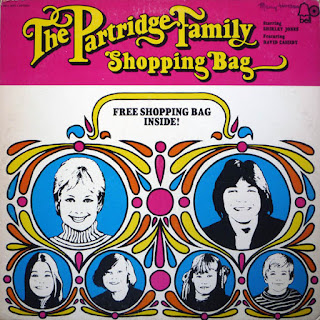
The Partridge Family Featuring Shirley Jones Starring David Cassidy —“It’s One of Those Nights (Yes Love)”. Bell 45160. Top 40 debut: 1/1/72. Peak date: 1/29/72. Written by Tony Romeo. Produced by Wes Farrell. B-side: “One Night Stand.” LP: Shopping Bag. Charts: Billboard Hot 100 (#24), Easy Listening (#2).

Strangely enough, the Partridge Family’s “It’s One of Those Nights (Yes Love)” came and went—peaking in late January ‘72—before its supporting album ever reached stores in March. It was in March, too, when the episode featuring the TV family’s single finally aired (“The Partridge Papers,” about sister Laurie’s stolen diary). It seems like a better synchronized push might have helped it.

What’s significant about this song, though, is that it peaked at #20 on the pop charts, but climbed to #2 on the easy listening charts. This was their most lopsided and therefore most revealing teenage vs. adult audience ratio yet. In spite of David Cassidy and company's so-called bubblegum appeal, the music, in sound and sales tactics, never wavered from targeting the buying power of the mom and dad demographic. None of their music really raged with the kind of adolescent libido that even the Osmonds could summon, and the chart performance of “It’s One of Those Nights” puts this reality into sharp focus. You always wondered why only adults seemed to attend their TV supper club music segments, right?

Partridge staff writer Tony Romeo gets sole credit for “It’s One of Those Nights,” which tapdanced around the essential chord structure of Frank and Nancy Sinatra’s “Somethin’ Stupid” (#1, 1966—itself a descendant of “Tea for Two”), from the pantheon of grandparent-friendly hits. Keeping with their tradition of the concept package, the supporting Shopping Bag album—the group’s fourth—included an actual plastic tote decorated with the album cover’s blue, yellow, and bubblegum-pink swirls, along wth the duotone faces of each member.

Also consistent with their recorded products, Shopping Bag’s full billing appeared on labels as “The Partridge Family Starring Shirley Jones Featuring David Cassidy,” and featured the production of future Tina Sinatra hubby Wes Farrell. Along with “It’s One of Those Nights,” the album included one more glaring template song in “Hello Hello,” which nabbed its title, various hooks, and arrangement ideas from Sopwith Camel, whose original “Hello Hello” reached #26 in 1967.

Shopping Bag offered up just one additional single for Hot 100 consideration a few months later, Irwin Levine and Russell Brown’s “Am I Losing You,” which stopped short at #59. Low memorability was as much to blame as was competition from David Cassidy’s second solo album. The still-viable TV group would be back in the Top 40 one more time before the year of ‘72 was over, though, with their version of Neil Sedaka’s “Breaking Up is Hard to Do” from a new album.

The "One Night Stand" b-side came from their previous album, The Partridge Family Sound Magazine, but didn't show up on an episode until March '73 ("Diary of a Mad Millionaire," featuring John "Gomez Addams" Astin as an eccentric, Howard Hughes type). The song's lyrics emphasized the traveling band aspect of the title phrase more than the bedroom one.

Side A: "It's One of Those Nights (Yes Love)"


Side B: "One Night Stand"

Saturday, August 10, 2013

The Sugar Bears' Cereal Box Hit

Released at the very tail end of the classic bubble gum era, the Sugar Bears' "You  Are the One" was one of five songs included on a cardboard EP you could cut out from certain 1972 boxes of Super Sugar Crisp. Amazingly enough, Sugar Bear (voiced by ex-First Edition member Mike Settle) and his band of animated mascot sidekicks (including Kim Carnes as "Honey Bear") sold enough of a corresponding 45 of "You Are the One" for it to climb up all the way to #51 on the Billboard Hot 100. No mean feat for a cereal box promotion in any era. As for the Partridge-esque song itself, producer Jimmy Bowen is the one who put it together, and it’s hardly the best this genre got, although it does benefit from a certain Phil Spector cognizance. (I’ll need to refresh my memory and see if Bowen mentions this particular project in his “unapologetic” Rough Mix.)

The Sugar Bears - "You Are the One" (Billboard #51, entered 3/11/72). Written by Baker Knight. Produced by Jimmy Bowen. 45: "You Are the One"/"Someone Like You" (Big Tree 1972). LP: Presenting the Sugar Bears (Big Tree 1971).

Tuesday, August 23, 2011

Food and "Whiteness" at MGM Records

"Milk and cookies," "milquetoast," "whipped cream" and "white bread" were terms one expected to hear in reference to MGM acts like the Cowsills, the Osmonds, and Pat Boone (an actual dairy spokesman) during the late '60s/early '70s. Helmed by the future Republican governor of California, Mike Curb, the label strove to project a clean, family-oriented image amid the unprecedented drug- and sex-friendliness of the music industry of the day. In response to the FCC's call for less narcotics on the airwaves, for example, Curb made Billboard headlines in 1970 by dropping 18 of his "progressive rock" and "hard drug groups" all at once. Curb also viewed the food-related descriptions mentioned above, evidently, as positive signifiers of cleanliness and whiteness or, maybe, whiteness-as-cleanliness. The Mike Curb Congregation's own "Sweet Gingerbread Man" (1970), though, demonstrated that no one was above the almighty double entendre.


The Cowsills surrounding a tower of white bread in the gatefold of The Cowsills (1967)


Whipped cream cake and dairy cows on the back of the Osmonds' Homemade (1971)

Milk as a central image for a 1972 Cashbox ad for Pat Boone and the Boone Girls' "Mr. Blue" single

The Mike Curb Congregation's "Sweet Gingerbread Man," in contrast, peddled cookies as "tasty and tan," naughty and nice.

Tuesday, July 5, 2011

Casablanca Records and the "New Bubblegum"


What I especially appreciate about Larry Harris's recent book And Party Every Day: The Inside Story of Casablanca Records is that it offers a human relations perspective on a label that still epitomizes carefree '70s hedonism and excess. Harris (former Executive VP and Managing Director of the label) knew and loved Casablanca head Neil Bogart, but also regretted a good many of his tactics and decisions. The label, after all, was notorious for its willingness, as Art Kass puts it in Fredric Dannen 's Hit Men (1991), to spend "three dollars to make two dollars."

I suspect those familiar with some of the stories in Hit Men and elsewhere will be disappointed with the low volume of additional shockers offered up by Harris, whose purpose is not so much to top or refute familiar tales, but to offer some insight into the thought processes of those in charge. I, for one, loved reading about all the radio promo Harris was involved in, working his contacts at WBCN in Boston, WSHE in St. Louis, WNEW in New York, and WMMS in Cleveland, to name only a few. Harris also takes Dannen's revelations concerning the pop-chart doctoring activity of Billboard chart editor Bill Wardlow a step further in a chapter titled "Writing the Charts" - the title of which is evidently no exaggeration.

In Early '70s Radio, I talk about Neil Bogart as one of the key cultivators of the preteen market in the late '60s, which developed into something formidable in the early '70s. He coined the term "bubblegum" for the double entendre-prone genre that flourished under his watch. The preteen market-on-steroids nature of Casablanca in the late '70s, for which the word "transgressive" might apply, was at once an innovation of Bogart's and a natural result of broader, post-sexual revolution cultural forces. Kids loved Kiss, Donna Summer, and the Village People, and observant adults knew that all three trafficked openly in sexual connotations. This was "the new bubblegum," a term Harris uses for another chapter title.

I was curious, incidentally, when I got my hands on the book, to see if I could learn more about Dannen's report in Hit Men about an "adorable little girl" who would make daily rounds in the Casablanca offices to take drug orders, which kinda strikes me as child exploitation to the utmost. Harris claims, though, that this story was probably a cover up fabricated by Dannen's source, Danny Davis. The drug runner, says Harris, was likely an adorable little boy.